

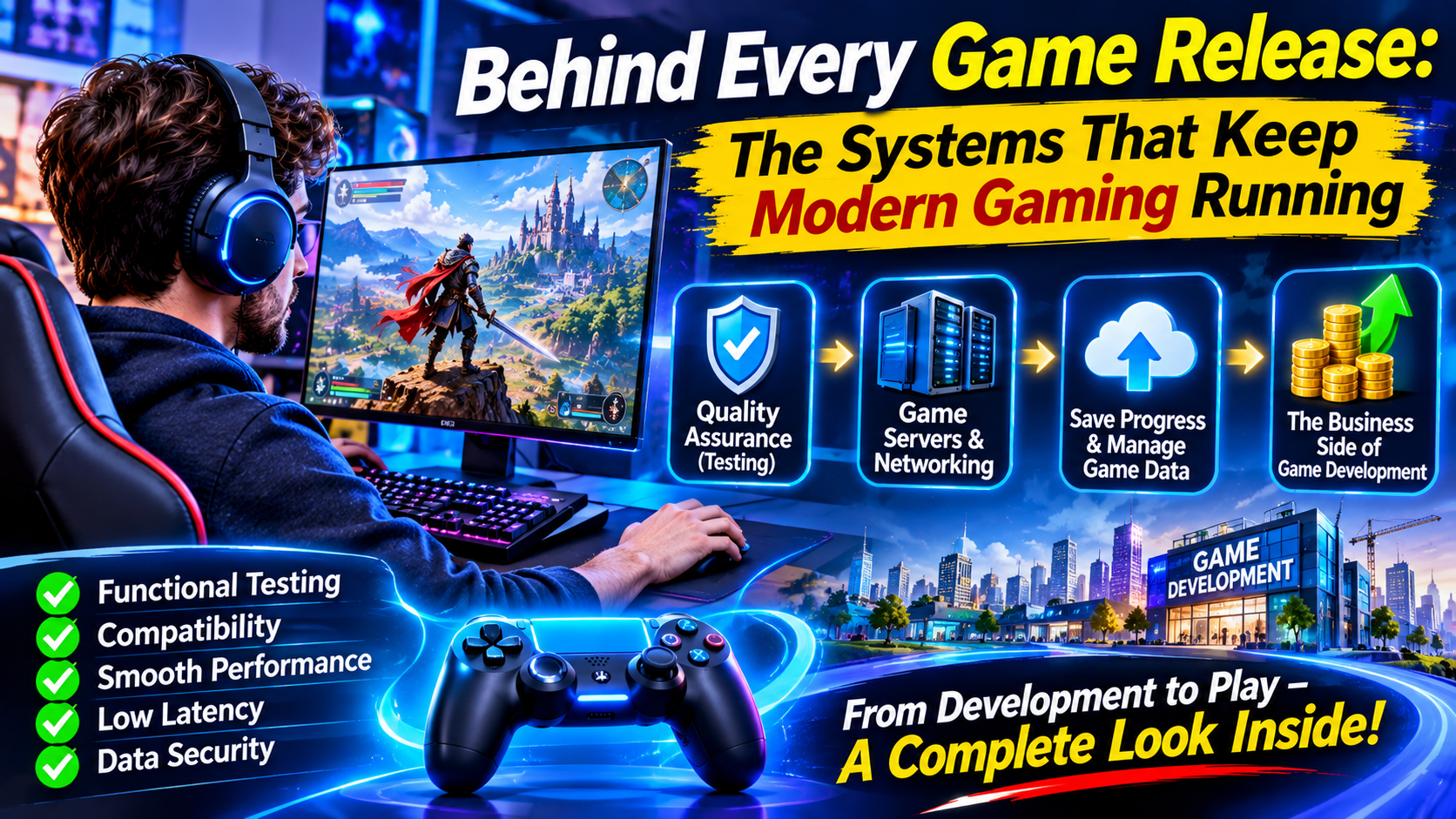
Launching a video game involves considerably more work than producing its visual assets and programming its main mechanics. Before a title reaches its audience, numerous systems must work together to support installation, account management, data storage, online connectivity, and consistent performance.
These supporting elements are not always visible during ordinary gameplay, yet they influence how reliably a game operates. A well-developed title depends on both its interactive content and the infrastructure responsible for delivering that content.
Understanding these components provides a different perspective on the gaming industry and explains why maintaining a successful release requires continuous technical attention.
Quality Assurance: Checking a Game Before Release
Game testing is an essential part of production. Its purpose is to identify problems that could interfere with gameplay, technical functionality, or the overall presentation.
Functional Testing
Testing teams examine whether individual features operate according to their intended specifications.
This can involve checking menus, character interactions, mission objectives, inventory systems, and other gameplay components.
The objective is to identify unexpected behavior before it affects the final release.
Compatibility Evaluation
Games may operate across different hardware configurations and operating systems.
Testing compatibility helps developers identify differences in performance, supported features, and interface behavior.
This process is particularly important when a title is distributed across several platforms.
User Experience Evaluation
Technical functionality does not automatically guarantee an understandable experience.
Testers may examine whether instructions are clear, menus are easy to navigate, and important gameplay information is presented consistently.
Their observations can help developers improve the product before publication.
The Technology Behind Online Game Servers
Online multiplayer experiences depend on infrastructure that allows connected devices to exchange information.
Server systems help coordinate shared activities and maintain communication between participants.
Managing Multiplayer Sessions
When players enter an online match, the game needs a system to organize the session.
Depending on its architecture, this may involve dedicated servers, peer-to-peer communication, or a combination of networking technologies.
Each approach has different technical requirements and operational considerations.
Understanding Latency and Network Stability
Latency refers to the delay involved in transmitting information between connected systems.
High latency can affect how quickly actions appear within an online environment.
Developers use different networking techniques to improve responsiveness and maintain consistency across multiplayer sessions.
Server Capacity and Availability
Online services must accommodate varying numbers of connected users.
Infrastructure planning helps determine how computing resources are allocated during normal activity and periods of increased demand.
Maintenance and monitoring are also important for identifying service interruptions.
Saving Progress and Managing Game Data
Players often spend considerable time completing objectives, unlocking features, and developing their in-game profiles.
Reliable data management helps preserve this progress.
Local Save Systems
Some games store progress directly on the device.
Local storage can support offline functionality, although the availability of saved information may depend on the device and software installation.
Cloud-Based Synchronization
Cloud saving allows compatible games to store selected information on remote infrastructure.
This can make progress available across supported devices, provided that account access and synchronization requirements are satisfied.
Backup and Recovery Considerations
Data recovery systems help address certain problems involving damaged or unavailable saved information.
Players should understand the backup options offered by their chosen platform and avoid assuming that every title automatically supports cloud recovery.
The Economics of Developing a Commercial Game
Producing and maintaining a commercial game requires financial planning across multiple stages.
Development budgets can involve personnel, software, equipment, licensing, marketing, distribution, and post-release support.
Production Costs and Resource Allocation
Different genres require different production resources.
A large three-dimensional adventure may involve extensive animation, environmental modeling, and voice production.
Meanwhile, a smaller puzzle title may prioritize level design, interface development, and gameplay testing.
The allocation of resources depends on the project’s objectives and production scope.
Licensing and Intellectual Property
Game development may involve licensed music, visual assets, software technologies, or other intellectual property.
Development teams need to understand the permissions associated with these materials.
Proper licensing arrangements help establish clear ownership and usage conditions.
Revenue and Distribution Arrangements
Games can generate revenue through several distribution models.
These include premium purchases, subscriptions, downloadable expansions, and optional in-game content.
Each model has different commercial requirements and can influence how a publisher plans long-term support.
Protecting Player Accounts and Digital Purchases
Account security is another important component of modern gaming services.
Many platforms connect user profiles with saved progress, purchase histories, social features, and other personal settings.
Account Authentication
Authentication systems help verify that someone attempting to access an account is authorized to do so.
Depending on the platform, available methods may include passwords, verification codes, and additional security options.
Recognizing Suspicious Communication
Players may encounter messages that imitate official game announcements or customer support services.
Unverified links and unexpected requests for account credentials should be treated cautiously.
Using official support channels helps reduce the risk of account-related problems.
Protecting Digital Transactions
Purchases made through gaming platforms should be reviewed carefully.
Users should understand pricing, transaction confirmation procedures, refund conditions, and the rules associated with digital products.
Clear transaction information contributes to a more transparent purchasing experience.
Maintaining Game Performance After Launch
A release is not necessarily the final stage of a game’s development.
Software updates may be required to address newly discovered problems, maintain compatibility, or introduce additional functionality.
Patch Development
Patches are updates designed to modify or correct selected parts of a game.
They may address bugs, improve performance, adjust interfaces, or resolve compatibility issues.
The contents of each update depend on the problems and improvements identified by the development team.
Monitoring Technical Performance
Developers can evaluate performance information to identify recurring issues.
Measurements may involve loading behavior, crash reports, server availability, and other technical indicators.
These findings can help determine which areas require further attention.
Communicating Changes to Players
Release notes explain what has changed in a particular update.
Clear documentation allows players to understand new features, technical adjustments, and known limitations.
It also provides a useful record of how a game develops over time.
The Importance of Digital Distribution
Digital distribution has changed how games reach audiences.
Instead of relying exclusively on physical retail products, publishers can distribute compatible releases through online storefronts and platform-specific services.
Download Management
Digital storefronts provide systems for obtaining and installing games.
Download sizes, available storage, operating system requirements, and connection quality can influence the installation process.
Product Information and Ratings
Storefront pages commonly display descriptions, technical requirements, screenshots, and other relevant information.
These details help potential users evaluate whether a title matches their expectations.
Regional Availability
Some releases have different availability conditions depending on geographical markets.
Distribution arrangements, language support, local regulations, and publishing agreements can influence where particular titles are offered.
How Gaming Hardware Influences Software Development
The capabilities of gaming hardware influence what developers can create and how their products perform.
Different devices provide different processing resources, storage configurations, and input methods.
Processing and Memory Requirements
Modern Togel158 can involve complex calculations, detailed environments, and numerous simultaneous interactive elements.
Processing capacity and available memory influence how efficiently these systems operate.
Developers must consider these limitations when optimizing their products.
Storage Technology and Loading Times
Storage devices affect how quickly game files can be accessed.
The organization of assets and loading processes can also influence performance.
Efficient data management helps reduce unnecessary delays during gameplay.
Display and Refresh Capabilities
Supported screen resolutions and refresh rates influence how visual content is presented.
Togel158 settings allow compatible devices to balance visual quality and performance according to available hardware.
The Future of Game Maintenance and Digital Services
As gaming becomes increasingly connected, the systems supporting digital entertainment will continue developing.
Improved cloud infrastructure, automated testing, advanced monitoring, and more flexible distribution methods may influence how publishers manage their products.
Developers may also place greater emphasis on compatibility across different devices and operating environments.
However, technical improvements must be accompanied by transparent policies, reliable support, and appropriate protection of player information.
A modern video game is supported by a complex collection of technical and operational systems.
Testing procedures, server infrastructure, data management, account security, distribution services, and ongoing maintenance all contribute to the final experience.
Although these components may operate behind the scenes, their importance becomes clear whenever players access online features, preserve progress, install updates, or interact with digital services.
Understanding the work involved beyond gameplay highlights how much coordination is required to deliver and maintain modern interactive entertainment.
